Climate Action
Regional Environmental Partnerships
Átl’ka7tsem/Howe Sound UNESCO Biosphere Region
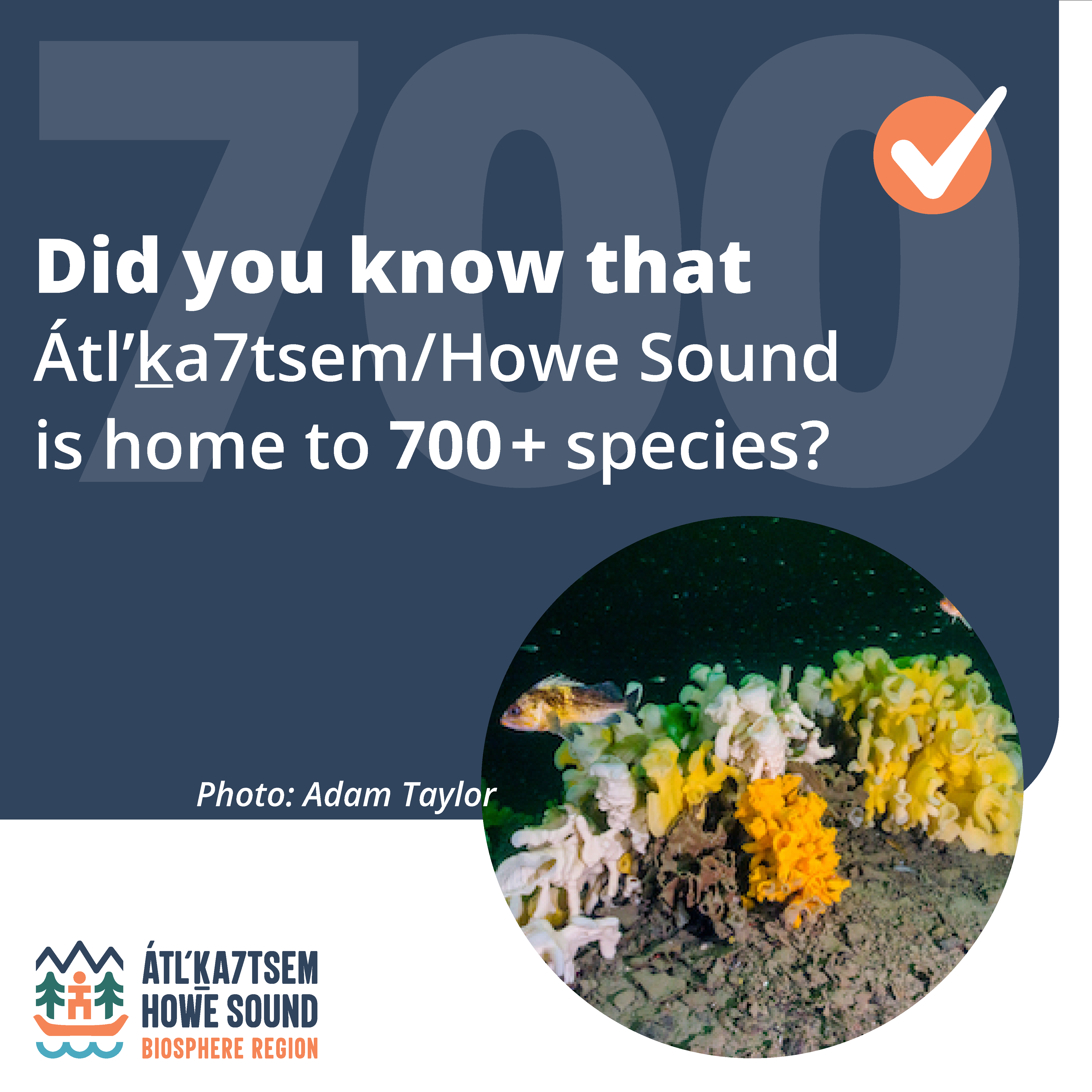
On September 15, 2021, Átl’ka7tsem/Howe Sound became Canada’s 19th UNESCO Biosphere Region.
That means the entire Howe Sound watershed (including the Town of Gibsons) has been given worldwide recognition as an area of importance by the United Nations Educational, Scientific and Cultural Organization and is a zone of global ecological significance.
The Biosphere Region, located on the territories of the Coast Salish people, covers a 218,723-hectare swath of land and sea encompassing the entire Howe Sound watershed. Its zoning boundaries begin near Point Atkinson (Sḵ’íw̓itsut) in West Vancouver, running north to Black Tusk (T’eḵt’aḵmúy̓in tl’a In7iny̓áx̱a7en) near Whistler, and as far west as Gower Point on the Sunshine Coast. The core protected area traverses five BC Provincial Parks, one BC Provincial Conservancy, and several marine refuges. Download map here.
The prestigious designation is meant to encourage sustainable development within the region, and to identify the biosphere as a place of learning, science, research and restoration.
Ocean Watch Action Committee
The Town of Gibsons is part of the Ocean Watch Action Committee which brings together elected officials, government staff and advisors to advance government actions identified by the Ocean Wise Report – Ocean Watch Átl’ḵa7tsem/Txwnéwu7ts/Howe Sound Edition 2020. The Action Committee seeks to advance the seven key actions highlighted in the report to keep track of progress. Updates are submitted by participating organizations. The seven Action Items include:
- Increase knowledge of the local area and species through research;
- Protect and restore marine species, habitats and ecosystem services
- Increase awareness and education and ensure consistent messaging on environmental issues;
- Drive high-level change using official channels (e.g. guidelines, policies, bylaws) appropriate to the circumstances;
- Financially support conservation actions and ensure stricter enforcement;
- Collect long-term data to identify trends, support decision-making, and evaluate the outcome of actions taken; and
- Decrease greenhouse gas emissions and move toward zero carbon municipalities to align with recommended reductions in global greenhouse gas emissions e.g. IPCC, Paris Agreement, Copenhagen Accord.
Coastal Flood Mapping Project
The Lower Sunshine Coast is defined by its proximity to the ocean. With over 509 kilometres of coastline, flooding from sea level rise and increased storm wave action is a growing hazard facing the region.
This project explores the challenges and risks for vulnerable areas and how our community can become more resilient to coastal flooding.
Working together, the Sunshine Coast Regional District (SCRD), Town of Gibsons, District of Sechelt and the Islands Trust, launched the Coastal Flood Mapping project to better understand current and future flood hazards and inform land use planning to address them.
The project will update coastal flood hazard mapping for a range of future sea level rise scenarios, and develop recommendations for adaptation and updates to Official Community Plan guidelines for development along the coast.